

If your veterinarian recommends an echocardiogram for your dog, you may wonder what the test can detect, why it’s needed and whether your dog will need sedation.
A dog echocardiogram is an ultrasound examination of the heart. It provides real-time images that allow veterinarians to evaluate the heart’s chambers, valves, walls, movement and function. An echocardiogram may be recommended when a dog has a heart murmur, suspected heart disease or other cardiac concerns.
Boca Veterinary Clinic offers same-day echocardiogram capabilities in Boca Raton as part of our advanced veterinary diagnostic services.
Boca Veterinary Clinic
22191 Powerline Rd, Suites 14A–B
Boca Raton, FL 33433
Phone: 561-392-6540
Key Takeaways
- An echocardiogram is an ultrasound examination of your dog’s heart.
- It provides real-time images of the heart’s structures and movement.
- Veterinarians may recommend an echo after detecting a heart murmur or other cardiac concern.
- Echocardiography can evaluate heart chambers, valves, wall thickness and heart function.
- Doppler ultrasound can provide information about blood flow through the heart.
- An echocardiogram, ECG and chest X-ray provide different types of cardiac information.
- Many dogs can have an echocardiogram without sedation.
- A small area of fur may need to be clipped to obtain clear images.
- Echocardiography is noninvasive and doesn’t use ionizing radiation.
- Boca Veterinary Clinic offers same-day echocardiogram capabilities in Boca Raton.
What Is a Dog Echocardiogram?
An echocardiogram—often called an “echo”—is a specialized ultrasound examination of the heart.
Ultrasound technology uses high-frequency sound waves to create images of structures inside the body.
During an echocardiogram, the ultrasound probe is positioned against your dog’s chest so the veterinarian can obtain moving images of the heart.
Unlike a standard photograph or X-ray, echocardiography allows the heart to be evaluated while it’s beating.
This can provide valuable information about how the heart is structured and functioning.
What Does an Echocardiogram Show in Dogs?
An echocardiogram can provide information about several important aspects of your dog’s heart.
These can include:
- Heart chamber size
- Heart wall thickness
- Heart valve structure
- Heart valve movement
- Heart muscle contraction
- Overall cardiac function
- Blood flow through portions of the heart
- Fluid around the heart
- Certain congenital abnormalities
- Other structural changes
The findings can help your veterinarian determine whether additional testing, monitoring or treatment may be appropriate.
Why Would My Dog Need an Echocardiogram?
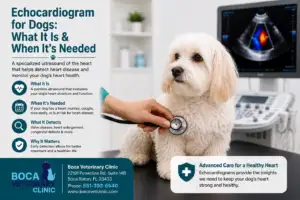
A veterinarian may recommend an echocardiogram when a physical examination or another diagnostic test raises concern about your dog’s heart.
Common reasons include:
- A newly detected heart murmur
- A known heart murmur that requires further evaluation
- Suspected heart disease
- Certain abnormal heart rhythms
- Changes seen on chest X-rays
- Exercise intolerance
- Certain breathing problems
- Weakness or collapse
- Suspected congenital heart disease
- Monitoring an existing cardiac condition
Not every dog with one of these symptoms necessarily has heart disease.
The purpose of diagnostic testing is to determine what’s causing the abnormality.
Does My Dog Need an Echocardiogram for a Heart Murmur?
A heart murmur is one of the most common reasons a veterinarian may recommend an echocardiogram.
A heart murmur is an abnormal sound heard when listening to the heart with a stethoscope.
The murmur itself isn’t a specific disease.
It reflects turbulent blood flow and can occur for different reasons.
An echocardiogram can help veterinarians evaluate the heart’s structure and function to better understand the cause and significance of a murmur.
The appropriate testing depends on factors such as:
- Your dog’s age
- Breed
- Murmur characteristics
- Symptoms
- Medical history
- Other examination findings
Does a Heart Murmur Mean My Dog Has Heart Disease?
Not necessarily.
Heart murmurs can have different causes and levels of significance.
Some dogs may have a murmur without showing signs of heart failure, while other murmurs may be associated with structural heart disease.
This is why hearing a murmur with a stethoscope doesn’t necessarily provide enough information by itself.
Your veterinarian may recommend additional testing to determine what’s causing the murmur.
What Heart Conditions Can an Echocardiogram Help Evaluate?
Echocardiography may help veterinarians evaluate various structural and functional heart abnormalities.
Examples can include:
- Valve abnormalities
- Enlargement of heart chambers
- Changes in heart muscle thickness
- Changes in contraction
- Congenital heart abnormalities
- Fluid surrounding the heart
- Certain changes associated with cardiomyopathy
- Other structural heart problems
An echocardiogram doesn’t replace every other cardiac test.
Veterinarians often combine the results with the physical examination, medical history and other diagnostic findings.
What Is Doppler Echocardiography?
Doppler is an ultrasound technique that provides information about blood flow.
During an echocardiogram, Doppler imaging may help evaluate:
- Direction of blood flow
- Speed of blood flow
- Abnormal flow patterns
- Blood movement across heart valves
This information can help veterinarians better understand how structural abnormalities are affecting heart function.
Echocardiogram vs. ECG: What’s the Difference?
These tests have similar-sounding names but evaluate different aspects of the heart.
Echocardiogram
An echocardiogram uses ultrasound to evaluate the heart’s physical structures and movement.
It provides information about:
- Chambers
- Valves
- Heart muscle
- Contraction
- Blood flow
- Structural abnormalities
ECG or EKG
An electrocardiogram (ECG or EKG) measures the heart’s electrical activity.
It’s particularly useful for evaluating heart rate and rhythm.
One test doesn’t replace the other.
A veterinarian may recommend either or both depending on the suspected problem.
Echocardiogram vs. Chest X-Ray
Chest X-rays and echocardiograms also provide different information.
Chest X-Rays
Digital radiographs can help veterinarians evaluate:
- Overall heart size and shape
- Lungs
- Airways
- Chest structures
- Certain changes associated with heart disease
Echocardiogram
An echocardiogram provides detailed real-time information about the structures inside the heart and how the heart is functioning.
Depending on your dog’s symptoms, a veterinarian may recommend both tests.
Echocardiogram vs. Abdominal Ultrasound
Both procedures use ultrasound technology, but they examine different parts of the body.
Echocardiogram: evaluates the heart.
Abdominal ultrasound: evaluates abdominal organs such as the liver, kidneys, spleen, bladder, stomach, intestines, pancreas and adrenal glands.
Boca Veterinary Clinic provides both abdominal ultrasound and echocardiogram capabilities.
Does My Dog Need Sedation for an Echocardiogram?
Many dogs can undergo an echocardiogram without sedation.
The procedure is noninvasive, and dogs can often remain awake during the examination.
However, sedation may sometimes be considered if a dog is extremely anxious, uncomfortable or unable to remain sufficiently still.
Whether sedation is appropriate depends on the individual patient.
Does an Echocardiogram Hurt a Dog?
An echocardiogram is generally noninvasive and not painful.
Your dog will need to remain relatively still while the ultrasound probe is placed against the chest.
Gentle pressure may be applied to obtain different images of the heart.
The veterinary team will work to keep your dog as comfortable as possible during the examination.
Will My Dog Need to Be Shaved for an Echocardiogram?
A small amount of fur may need to be clipped from portions of the chest.
Hair can trap air between the ultrasound probe and skin, which interferes with ultrasound imaging.
Ultrasound gel is typically applied to help the probe make good contact with the skin.
The clipped fur will grow back.
Is an Echocardiogram Safe for Dogs?
Echocardiography is widely used in veterinary medicine.
The test uses sound waves and doesn’t expose your dog to ionizing radiation.
It’s also noninvasive when performed as a standard diagnostic examination.
How Long Does a Dog Echocardiogram Take?
The length of the examination can vary based on:
- Your dog’s cooperation
- The complexity of the heart condition
- The number of measurements required
- Whether additional diagnostic procedures are performed
Your veterinary team can provide more specific information when the examination is scheduled.
How Should I Prepare My Dog for an Echocardiogram?
Preparation requirements can vary.
Your veterinary team may provide instructions regarding:
- Food
- Water
- Medications
- Arrival time
Don’t discontinue heart medications or other prescribed medications unless your veterinarian specifically instructs you to do so.
Bring information about any medications or supplements your dog is currently taking.
What Happens During a Dog Echocardiogram?
Although procedures can vary, a typical examination involves several steps.
- Your Dog Is Positioned for Imaging
Your dog is positioned so the ultrasound probe can access different areas of the chest.
- Fur May Be Clipped
Small areas may be clipped to improve image quality.
- Ultrasound Gel Is Applied
Gel helps create proper contact between the ultrasound probe and skin.
- Images of the Heart Are Collected
The veterinarian obtains images from several angles.
Measurements may be taken of:
- Heart chambers
- Heart walls
- Valves
- Other structures
- Blood Flow May Be Evaluated
Doppler ultrasound may be used to evaluate blood flow.
- Findings Are Interpreted
The echocardiogram findings are considered along with your dog’s symptoms, physical examination and other diagnostic information.
What Happens After My Dog’s Echocardiogram?
The next step depends on the results.
Your veterinarian may recommend:
- No immediate treatment
- Continued monitoring
- Medication
- Additional diagnostic testing
- Follow-up echocardiograms
- Changes to an existing treatment plan
- Specialist consultation
The goal is to understand the heart’s condition well enough to determine an appropriate plan for your dog.
Can a Dog Have Heart Disease Without Symptoms?
Yes.
Some dogs with heart disease may show few or no obvious symptoms during earlier stages.
A veterinarian may first detect an abnormality during a routine examination, such as a heart murmur.
This is one reason regular wellness examinations are valuable.
Listening to your dog’s heart during routine visits can sometimes identify changes before you notice obvious symptoms at home.
What Are Signs of Heart Problems in Dogs?
Symptoms can vary depending on the condition and severity.
Possible signs include:
- Coughing
- Difficulty breathing
- Rapid breathing
- Reduced exercise tolerance
- Weakness
- Collapse or fainting
- Restlessness
- Reduced activity
- Abdominal swelling
- Changes in appetite
These symptoms aren’t specific to heart disease and can occur with other medical conditions.
A veterinary examination is necessary to determine the cause.
Is Coughing Always a Sign of Heart Disease?
No.
Dogs can cough for many reasons, including respiratory and airway conditions.
However, coughing may sometimes occur in dogs with cardiac disease.
Your veterinarian may recommend diagnostic testing such as:
- Physical examination
- Chest X-rays
- Blood testing
- Echocardiography
- Other tests
The appropriate workup depends on your dog’s symptoms and examination findings.
Is Difficulty Breathing a Pet Emergency?
Difficulty breathing should be treated as an emergency.
Seek immediate veterinary care if your dog is:
- Struggling to breathe
- Gasping
- Breathing with significant effort
- Developing blue or gray gums
- Collapsing
- Showing severe respiratory distress
Don’t wait for severe breathing problems to resolve on their own.
Can Heart Disease Be Treated in Dogs?
Treatment depends on the specific heart condition and its severity.
Depending on the diagnosis, management may involve:
- Medication
- Dietary recommendations
- Exercise recommendations
- Monitoring
- Follow-up imaging
- Treatment of underlying conditions
Not every cardiac abnormality requires the same treatment.
An accurate diagnosis helps your veterinarian develop an appropriate management plan.
How Often Does a Dog Need an Echocardiogram?
There isn’t a universal schedule.
Some dogs may need only one diagnostic echocardiogram, while dogs with known cardiac disease may need periodic follow-up imaging.
Frequency depends on:
- Diagnosis
- Severity
- Symptoms
- Medications
- Changes in condition
- Your veterinarian’s recommendations
Follow the monitoring schedule recommended for your individual dog by your veterinarian.
Do Senior Dogs Need Echocardiograms?
Not every senior dog automatically needs an echocardiogram.
However, older dogs have a greater likelihood of developing certain cardiac conditions.
Your veterinarian may recommend an echocardiogram if a senior dog’s examination identifies a heart murmur or if symptoms or other diagnostic tests raise concern about heart disease.
Do Puppies Ever Need Echocardiograms?
Yes.
A puppy may need an echocardiogram if a veterinarian detects a heart murmur or suspects a congenital heart abnormality.
Some puppy murmurs may be temporary or relatively harmless, while others require further evaluation.
Your veterinarian can determine whether additional cardiac testing is appropriate.
Same-Day Dog Echocardiograms in Boca Raton
Boca Veterinary Clinic offers same-day echocardiogram capabilities for dogs in Boca Raton.
Our full-service veterinary hospital also provides:
- Abdominal ultrasound
- Digital X-rays
- In-house laboratory testing
- Internal medicine
- Emergency and urgent veterinary care during operating hours
- Veterinary surgery
- Hospitalization
- Advanced diagnostic services
Combining cardiac imaging with additional diagnostic capabilities allows our veterinary team to evaluate your dog’s overall medical condition when necessary.
Boca Veterinary Clinic serves pet owners throughout Boca Raton and nearby Parkland, Coconut Creek, Deerfield Beach and Delray Beach.
Boca Veterinary Clinic
22191 Powerline Rd, Suites 14A–B
Boca Raton, FL 33433
Call 561-392-6540 to discuss your dog’s echocardiogram needs or current availability.
Frequently Asked Questions About Dog Echocardiograms
What does an echocardiogram show in a dog?
An echocardiogram provides real-time images of the heart and can help veterinarians evaluate the heart chambers, valves, walls, movement, function and certain blood-flow patterns.
Why would my dog need an echocardiogram?
Common reasons include a heart murmur, suspected heart disease, certain abnormal heart rhythms, changes on chest X-rays, exercise intolerance or other cardiac concerns.
Does my dog need an echocardiogram if they have a heart murmur?
Not every heart murmur has the same significance. Your veterinarian may recommend an echocardiogram to determine whether structural heart disease is present and better understand the cause of the murmur.
Is a dog echocardiogram painful?
A standard echocardiogram is noninvasive and generally not painful. Gentle pressure is applied to the chest with an ultrasound probe to obtain images.
Does a dog need sedation for an echocardiogram?
Many dogs can have an echocardiogram without sedation. Sedation may sometimes be considered for dogs that are extremely anxious or unable to remain sufficiently still.
Does my dog need to be shaved for an echocardiogram?
Small areas of fur may be clipped from the chest to improve contact between the ultrasound probe and skin and produce clearer images.
What’s the difference between an echocardiogram and an ECG?
An echocardiogram uses ultrasound to evaluate heart structures and function. An ECG or EKG measures the heart’s electrical activity and is particularly useful for evaluating heart rhythm.
What’s the difference between an echocardiogram and an X-ray?
Chest X-rays show the overall heart silhouette, lungs and other chest structures. An echocardiogram provides detailed moving images of structures inside the heart and information about cardiac function.
Can a dog have heart disease without symptoms?
Yes. Some dogs with heart disease may initially show few obvious symptoms. A veterinarian may first detect an abnormality such as a heart murmur during a routine examination.
Is difficulty breathing an emergency for a dog with heart disease?
Yes. Significant difficulty breathing should be treated as an emergency regardless of whether your dog has known heart disease.
How often will my dog need an echocardiogram?
Frequency depends on the diagnosis and your dog’s condition. Some dogs need only diagnostic imaging, while others with known heart disease may need periodic follow-up echocardiograms.
Where can I get a dog echocardiogram in Boca Raton?
Boca Veterinary Clinic offers same-day echocardiogram capabilities at 22191 Powerline Rd, Suites 14A–B, Boca Raton, FL 33433. Call 561-392-6540 to discuss your dog’s needs and current availability.