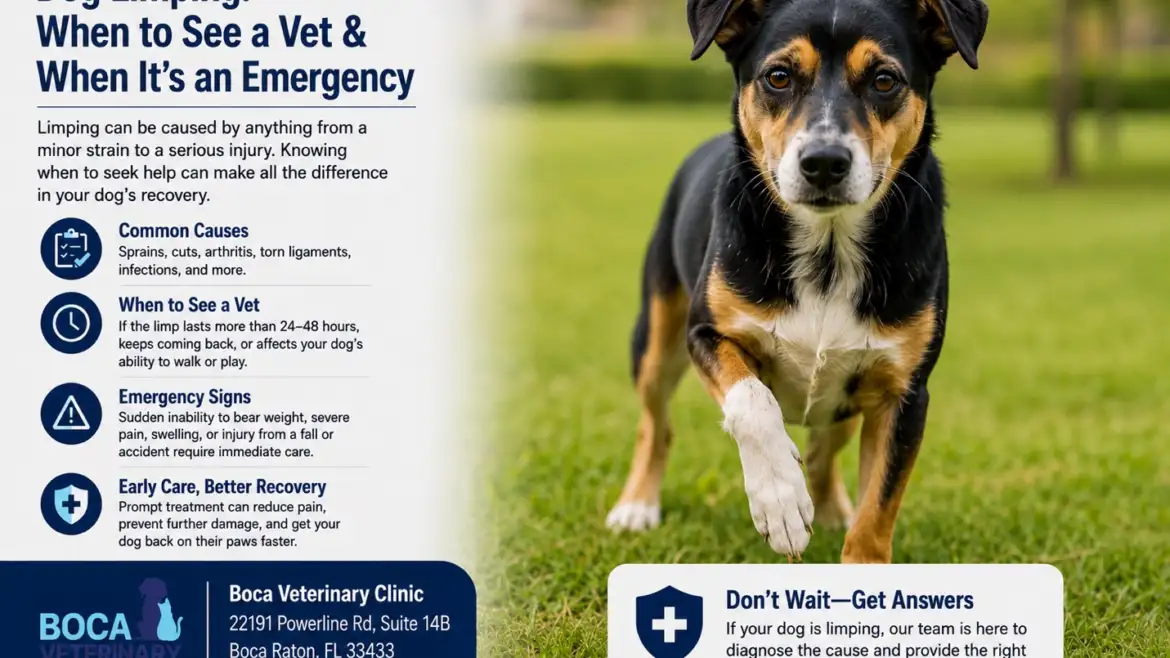
If your dog suddenly starts limping, the cause could be something relatively minor, such as a paw injury, or a more significant orthopedic or neurological problem. The severity of the limp and your dog’s other symptoms can help determine how quickly veterinary care is needed.
A dog should see a veterinarian for persistent, severe or unexplained limping. Seek more urgent veterinary care if your dog cannot put weight on the leg, has severe pain, an obvious fracture or deformity, significant swelling, uncontrolled bleeding, major trauma, sudden paralysis or an inability to stand or walk.
Boca Veterinary Clinic evaluates limping and mobility problems in dogs in Boca Raton, with diagnostic capabilities including physical examinations, digital X-rays, in-house laboratory testing and advanced veterinary care.
Boca Veterinary Clinic
22191 Powerline Rd, Suites 14A–B
Boca Raton, FL 33433
Phone: 561-392-6540
Key Takeaways
- Mild limping can have many causes, from paw irritation to joint or muscle injuries.
- Persistent or unexplained limping warrants veterinary evaluation.
- A dog doesn’t have to cry or whimper to be experiencing pain.
- A dog that cannot put any weight on a leg should be evaluated promptly.
- Major trauma, obvious fractures, severe pain and sudden paralysis require urgent veterinary attention.
- Check the paw for obvious problems, but don’t manipulate a painful leg aggressively.
- Don’t give your dog human pain medication unless a veterinarian specifically instructs you to do so.
- Digital X-rays can help evaluate bones and joints when an orthopedic problem is suspected.
- Senior dogs may develop mobility problems gradually, but new limping shouldn’t automatically be dismissed as old age.
- Sudden inability to stand or walk can indicate an emergency.
Why Is My Dog Limping?
Dogs limp when pain, weakness or another problem changes the way they normally use a limb.
The problem can originate in the:
- Paw
- Toenails
- Muscles
- Tendons
- Ligaments
- Joints
- Bones
- Spine
- Nervous system
Potential causes range from relatively minor injuries to significant orthopedic or neurological conditions.
A veterinary examination is often necessary when the cause isn’t obvious or the limp doesn’t resolve.
When Should I Take My Limping Dog to the Vet?
Contact your Boca Veterinary Clinic veterinarian when limping is persistent, significant, unexplained or accompanied by other concerning symptoms.
Your dog should be evaluated promptly if:
- The limp is severe
- Your dog won’t put weight on the leg
- Pain appears significant
- Swelling is present
- There is a wound
- A nail is badly damaged
- The limp follows trauma
- Your dog is unusually lethargic
- The limp keeps returning
- The problem is getting worse
- Your dog has difficulty standing
A very mild limp that quickly resolves in an otherwise normal dog may not necessarily be an emergency, but continue monitoring closely.
When Is Dog Limping an Emergency?
Limping can require emergency care when associated with a serious injury or sudden loss of function.
Seek immediate veterinary attention for:
- Being hit by a vehicle
- A serious fall
- An obvious fracture
- A visibly deformed limb
- Severe or uncontrolled bleeding
- Extreme pain
- Sudden inability to stand
- Sudden paralysis
- Significant spinal trauma
- Severe weakness or collapse
Don’t force a dog with a suspected fracture or spinal injury to walk.
Minimize movement and transport your dog carefully.
My Dog Is Limping but Not Crying. Should I Worry?
Yes, a dog can be in pain without crying or whimpering.
Dogs don’t always express discomfort vocally.
Other signs of pain can include:
- Limping
- Reduced activity
- Reluctance to climb stairs
- Difficulty standing
- Panting
- Restlessness
- Licking a particular area
- Changes in posture
- Avoiding being touched
- Behavioral changes
Don’t use the absence of crying as proof that an injury isn’t painful.
Why Is My Dog Suddenly Limping?
Sudden limping often suggests an acute problem.
Potential causes can include:
- Paw injury
- Broken nail
- Foreign material in the paw
- Muscle strain
- Ligament injury
- Joint injury
- Fracture
- Dislocation
- Insect bite or sting
- Other trauma
Think about what your dog was doing immediately before the limp began.
Did your dog:
- Run?
- Jump?
- Play roughly?
- Fall?
- Slip?
- Step on something?
- Get into a fight with another animal?
This information can help your veterinarian evaluate the problem.
My Dog Won’t Put Weight on Their Leg. Is That an Emergency?
A dog that refuses to bear weight on a leg should be evaluated promptly.
Complete non-weight-bearing lameness can occur with significant pain or injury.
Possible causes include:
- Fracture
- Ligament injury
- Severe paw injury
- Joint injury
- Dislocation
- Significant soft-tissue injury
- Other orthopedic problems
Avoid unnecessary exercise until your dog has been evaluated.
What Should I Check If My Dog Is Limping?
If your dog is calm and allows it, you can perform a gentle visual inspection.
Look at the:
- Paw pads
- Toenails
- Skin between the toes
- Top and bottom of the paw
Look for obvious problems such as:
- Cuts
- Bleeding
- Broken nails
- Swelling
- Thorns or other superficial foreign material
- Redness
Don’t aggressively bend, straighten or manipulate a painful leg.
A dog experiencing pain may bite even if normally gentle.
Could Something Be Stuck in My Dog’s Paw?
Yes.
Dogs can pick up foreign material while walking or running outdoors.
Examples include:
- Thorns
- Plant material
- Small pieces of debris
- Other sharp objects
South Florida dogs can encounter a variety of outdoor surfaces and vegetation, so paws should be inspected when limping begins suddenly after outdoor activity.
If something is deeply embedded, the paw is significantly swollen or your dog is very painful, contact Boca Veterinary Clinic immediately for help.
Can a Broken Toenail Make a Dog Limp?
Yes.
Broken or torn nails can be painful and may bleed significantly.
Some nail injuries are relatively minor, while others involve deeper structures and require veterinary treatment.
Contact your veterinarian if:
- Bleeding doesn’t stop
- The nail is partially detached
- Your dog is very painful
- Swelling develops
- Your dog continues limping
Don’t pull off a partially attached nail yourself.
Why Is My Dog Limping on a Front Leg?
Front-leg limping can originate anywhere from the paw to the shoulder or even involve the neck or nervous system.
Potential areas include:
- Paw
- Toes
- Wrist
- Elbow
- Shoulder
- Muscles and tendons
- Bones
- Nerves
Where your dog appears painful doesn’t always identify the true source of the problem.
A veterinary orthopedic examination can help localize the pain.
Why Is My Dog Limping on a Back Leg?
Back-leg limping can involve the:
- Paw
- Toes
- Hock
- Knee
- Hip
- Muscles
- Ligaments
- Bones
- Spine
- Nervous system
One common area veterinarians evaluate when a dog suddenly develops hind-leg lameness is the knee.
However, many different conditions can cause similar symptoms, so diagnosis shouldn’t be based on the appearance of the limp alone.
Could My Dog Have a Torn ACL?
Dogs have a cranial cruciate ligament (CCL) in the knee that performs a role similar to the human ACL.
CCL injuries are an important cause of hind-limb lameness in dogs.
Signs may include:
- Sudden back-leg limping
- Difficulty bearing weight
- Trouble standing
- Difficulty jumping
- Reduced activity
- Persistent or intermittent lameness
A veterinary examination is necessary to determine whether the CCL or another structure is responsible.
Why Is My Dog Limping After Running or Playing?
Limping after vigorous activity may be associated with:
- Muscle strain
- Paw injury
- Ligament injury
- Joint injury
- Other trauma
Restrict strenuous activity while monitoring your dog.
If the limp is severe, persists or your dog won’t bear weight on the limb, contact your veterinarian.
Why Is My Dog Limping After Sleeping?
Some dogs appear stiff when first getting up after resting.
This can sometimes occur with joint or mobility problems, particularly in older dogs.
Signs may include:
- Stiffness after sleeping
- Difficulty standing
- Limping that improves after moving
- Reluctance to climb stairs
- Reduced willingness to jump
Recurring stiffness warrants veterinary evaluation rather than simply assuming it’s normal aging.
Why Is My Senior Dog Limping?
Older dogs may develop mobility problems involving joints, muscles, bones or the nervous system.
Possible causes include:
- Osteoarthritis
- Previous injuries
- Orthopedic disease
- Muscle loss
- Neurological conditions
- Other age-related medical problems
New limping in a senior dog shouldn’t automatically be dismissed as old age.
Your veterinarian can determine whether pain or another treatable condition is present.
Can Arthritis Make a Dog Limp?
Yes.
Osteoarthritis can cause pain, stiffness and reduced mobility.
Possible signs include:
- Limping
- Stiffness
- Difficulty getting up
- Reluctance to climb stairs
- Difficulty jumping
- Reduced interest in exercise
- Slower walking
- Changes in behavior
Arthritis management should be individualized based on your dog’s health and severity of symptoms.
How Does a Veterinarian Diagnose Why a Dog Is Limping?
Diagnosis generally begins with a history and physical examination.
Your veterinarian may ask:
- When did the limp begin?
- Was it sudden or gradual?
- Which leg appears affected?
- Did an injury occur?
- Does the limp improve or worsen with activity?
- Is your dog taking medication?
- Has this happened before?
The veterinarian may then evaluate:
- Gait
- Paws
- Bones
- Joints
- Muscles
- Range of motion
- Areas of pain
- Neurological function when appropriate
Additional diagnostic testing may be recommended based on the findings.
Does My Limping Dog Need an X-Ray?
Digital X-rays can be very useful when a veterinarian suspects a bone or joint problem.
Radiographs may help identify:
- Fractures
- Certain joint abnormalities
- Bone changes
- Arthritis
- Some forms of trauma
- Other orthopedic abnormalities
However, not every cause of limping is visible on an X-ray.
Ligaments, tendons, muscles and neurological problems may require additional evaluation or imaging.
Can Blood Tests Help Diagnose Limping?
Sometimes.
Bloodwork doesn’t diagnose most mechanical orthopedic injuries directly, but it may be useful when a veterinarian suspects:
- Systemic illness
- Infection
- Inflammation
- Certain underlying diseases
Laboratory testing may also be recommended before medications, anesthesia or surgery depending on your dog’s condition.
Does a Limping Dog Need Surgery?
Not necessarily.
Treatment depends entirely on the diagnosis.
Some conditions may be managed with:
- Rest
- Activity modification
- Veterinary-prescribed medication
- Weight management
- Rehabilitation
- Acupuncture
- Other conservative treatments
Other injuries, such as certain fractures or ligament injuries, may require surgical treatment.
The first step is determining the cause of the limp.
What Can I Do at Home for a Limping Dog?
Until you know what’s causing the problem, restrict strenuous activity.
Avoid:
- Running
- Jumping
- Rough play
- Long walks
- Unnecessary stairs
Take your dog outside on a leash for controlled bathroom breaks when appropriate.
You can visually inspect the paw for obvious injuries if your dog allows it.
If the limp persists, worsens or is severe, contact your veterinarian.
Can I Give My Dog Ibuprofen for Limping?
Do not give your dog ibuprofen or other human pain medications unless a veterinarian specifically instructs you to do so.
Some medications commonly used by people can cause serious toxicity in dogs.
Veterinarians have medications specifically selected and dosed for canine patients.
Call Boca Veterinary Clinic before giving any medication.
Should I Massage My Dog’s Limping Leg?
Avoid aggressive massage or manipulation until you know what’s causing the limp.
If a fracture, ligament injury or other significant problem is present, manipulating the area could cause pain or potentially worsen the injury.
A veterinary diagnosis should come first.
How Long Should I Wait Before Taking My Limping Dog to the Vet?
There isn’t one waiting period appropriate for every dog.
Severe limping, inability to bear weight, significant pain or limping following major trauma should be evaluated promptly.
A very mild limp in an otherwise normal dog may sometimes improve with short-term activity restriction.
Contact your veterinarian if:
- The limp persists
- The limp worsens
- The limp returns repeatedly
- Your dog develops swelling
- Your dog’s behavior changes
- Your dog stops using the limb
When you’re uncertain, call your veterinarian rather than trying to determine the diagnosis yourself.
Can Obesity Make Mobility Problems Worse?
Excess body weight places additional mechanical stress on a dog’s joints and can make some mobility problems more difficult to manage.
Maintaining an appropriate body condition is therefore an important component of orthopedic and overall health.
Your veterinarian can help determine your dog’s ideal weight and recommend an appropriate nutrition plan.
How Can I Help Prevent Leg Injuries in My Dog?
Not every injury is preventable, but you can reduce some risks by:
- Maintaining a healthy weight
- Providing regular appropriate exercise
- Keeping nails properly trimmed
- Inspecting paws after outdoor activity
- Avoiding sudden excessive exercise in poorly conditioned dogs
- Using caution on slippery surfaces
- Scheduling regular veterinary wellness examinations
Senior dogs or dogs with known orthopedic problems may require additional adjustments.
When Should I Take My Limping Dog to an Emergency Vet?
Seek urgent or emergency veterinary care if your dog has:
- An obvious fracture
- A severely deformed limb
- Major trauma
- Severe uncontrolled bleeding
- Extreme pain
- Sudden paralysis
- Sudden inability to stand or walk
- Collapse
- Other severe symptoms accompanying the limp
If you’re unsure whether your dog’s injury is an emergency, call a veterinarian and describe what happened.
Dog Limping Evaluation in Boca Raton
Boca Veterinary Clinic evaluates dogs with limping, pain and mobility problems in Boca Raton.
Depending on your dog’s symptoms and examination findings, diagnostic and treatment capabilities include:
- Comprehensive physical examinations
- Orthopedic evaluation
- Digital X-rays
- In-house laboratory testing
- Pain management
- Veterinary surgery
- Senior dog care
- Urgent and emergency veterinary care during operating hours
Our full-service animal hospital is open seven days a week and serves pet owners throughout Boca Raton, Parkland, Coconut Creek, Deerfield Beach and Delray Beach.
Boca Veterinary Clinic
22191 Powerline Rd, Suites 14A–B
Boca Raton, FL 33433
Call 561-392-6540 if your dog is limping or you’re concerned about an injury or mobility change.
Frequently Asked Questions About Dog Limping
When should I take my limping dog to the vet?
Take your dog to a veterinarian if limping is persistent, severe, unexplained or getting worse. Prompt evaluation is especially important if your dog won’t put weight on the leg, has significant pain or was involved in an accident.
Is dog limping an emergency?
Mild limping isn’t always an emergency. Major trauma, obvious fractures, severe pain, uncontrolled bleeding, sudden paralysis or inability to stand or walk requires urgent veterinary attention.
Why is my dog limping but not crying?
Dogs don’t always vocalize when they’re in pain. Limping itself can be a sign of discomfort even when a dog isn’t crying or whimpering.
Why is my dog suddenly limping?
Sudden limping can result from a paw or nail injury, muscle strain, ligament injury, joint problem, fracture, dislocation or other trauma. Persistent or severe sudden limping warrants veterinary evaluation.
What should I do if my dog won’t put weight on one leg?
Restrict your dog’s activity and arrange prompt veterinary evaluation. Complete refusal to bear weight can indicate significant pain or injury.
Why is my dog limping on a back leg?
Back-leg limping can originate in the paw, knee, hip, muscles, ligaments, bones, spine or nervous system. A veterinary examination can help identify the source.
Could my dog’s limp be a torn ACL?
Dogs can injure their cranial cruciate ligament, which functions similarly to the human ACL. A CCL injury can cause sudden or persistent hind-leg lameness, but veterinary examination is necessary for diagnosis.
Why does my dog limp after sleeping?
Recurring stiffness or limping after rest can occur with joint and mobility problems, including osteoarthritis. Persistent symptoms should be evaluated by a veterinarian.
Does a limping dog need an X-ray?
Not every limping dog requires X-rays, but digital radiographs can help evaluate fractures, arthritis, bone changes and certain joint abnormalities. Your veterinarian will determine whether imaging is appropriate.
Can I give my limping dog ibuprofen?
Do not give your dog ibuprofen or other human pain medication unless specifically directed by a veterinarian. Some human medications can be toxic to dogs.
Should I walk my dog if they’re limping?
Avoid strenuous exercise while your dog is limping. Controlled leash trips for bathroom breaks may be appropriate, but running, jumping, rough play and long walks should generally be avoided until the cause is known.
Where can I take my limping dog in Boca Raton?
Boca Veterinary Clinic evaluates dogs with limping, injuries and mobility problems at 22191 Powerline Rd, Suites 14A–B, Boca Raton, FL 33433. Call 561-392-6540 for an appointment or to discuss urgent symptoms.
Emergency preparation resource: AVMA pet first aid and emergency transport guide. First aid does not replace veterinary care.